
Among the cliffs of Monte Gallo, near Mondello (Palermo, Sicily), lies the Grotta Regina, a natural cave of extraordinary archaeological and historical value. Used as a rock sanctuary during the 5th–2nd centuries BC, the cave preserves Punic inscriptions and figurative representations—ships, warriors, animals, and religious symbols—on its walls, bearing witness to the Carthaginian presence and the intense cultural exchange of the ancient Mediterranean.
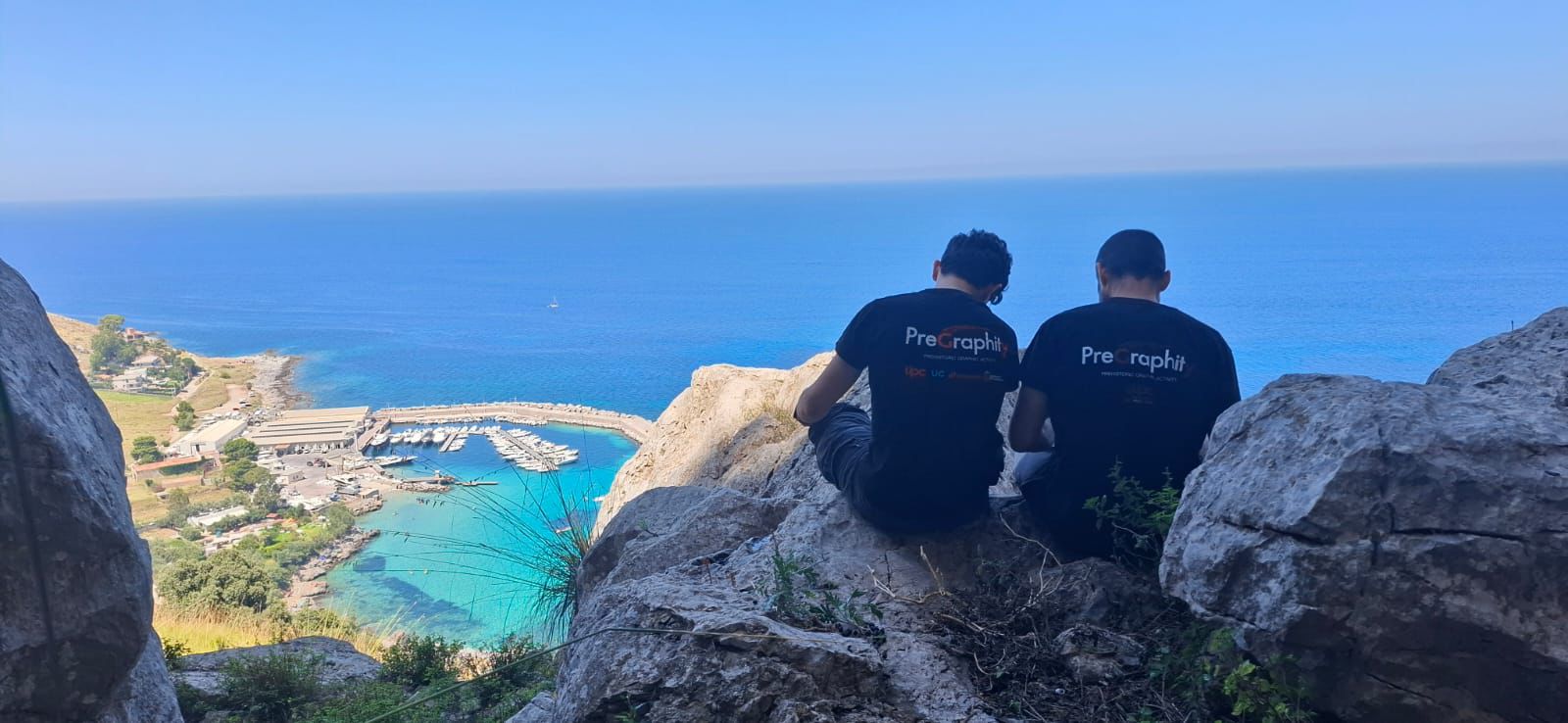
In June 2025, a team from the International Institute of Prehistoric Research of Cantabria (IIIPC) and the University of Cantabria, under the direction of Dr Diego Garate Maidagan, carried out the Grotta Regina Geomatics Digitisation Project, in collaboration with researcher Adriano Orsingher (Complutense University of Madrid). The main objective was to create a high-precision digital twin of the cave, which would allow this exceptional archaeological heritage to be documented, studied and preserved.
🎯 Project objectives
The project has been developed using advanced geomatics and archaeological documentation methodology, structured around the following specific objectives:
- Precise georeferencing of the cave using high-precision GNSS systems.
- Terrestrial laser scanning (Leica BLK360) to generate a three-dimensional point cloud of the interior of the cavity.
- Georeferenced photogrammetric survey, including:
- Aerial photogrammetry with a drone to contextualise the surroundings of Monte Gallo.
- High-resolution terrestrial photogrammetry of walls, ceilings and floors.
- Detailed photogrammetry of the panels with wall inscriptions.
- Graphic restitution of the documented inscriptions and decorative motifs.
- Archaeological survey of the interior and floors of the cave to identify associated materials and remains.
🧭 Results and relevance
The fieldwork, carried out between 25 and 28 June 2025, has made it possible to document more than 70 decorated panels with Punic and Greek inscriptions and religious symbols. The results include the creation of a photorealistic virtual replica of the cave, integrated into a georeferenced coordinate system, which is an essential tool for scientific research, conservation and heritage dissemination.
This project represents a pioneering advance in the application of geomatics technologies to the study of Mediterranean rock art. The creation of a digital twin of the Grotta Regina will not only preserve this site from natural deterioration, but also allow virtual access to its heritage from anywhere in the world, promoting interdisciplinary research and cultural dissemination.