
The project was initiated at the request of the Cultural Heritage Service of the Government of Cantabria to investigate the authenticity of some paintings found in the Coventosa Cave (Val de Asón, Arredondo). These drawings had been presented as a spectacular new collection of Palaeolithic cave art. The study was led by Diego Garate Maidagan and a team of specialists from the University of Cantabria. The Coventosa Cave is a very large cavity, but the panel studied is located in the vestibule, very close to the exterior, which means that it is directly exposed to sunlight and climatic changes (external dynamics).

Methodology
To verify the age of the paintings, the researchers designed a comprehensive proposal for documentation and scientific analysis. The methodology went beyond simple visual inspection, based on three pillars:
- Stylistic and Technical Analysis: Comprehensive documentation with high-resolution photography and study of technical procedures to compare them with genuine Palaeolithic art.
- Advanced Photogrammetry: Detailed digital models of the panel (microphotogrammetry) were created to study how the painting related to the natural processes of the rock (taphonomic processes).
- Bioarchaeological Analysis: Samples were taken from the biofilm, algae, and lichens present on the surface to determine whether these living organisms predated or postdated the painting.
Results:
Scientific analysis yielded multiple pieces of evidence demonstrating that the paintings are not from the Palaeolithic period. The most compelling results were:
Artistic and Technical Errors : The figures (partial representations of bovids) exhibited serious anatomical and stylistic inconsistencies that do not coincide with the conventions of Upper Palaeolithic rock art. For example, disproportionate ears, errors in the placement of the animal’s sex, and horn shapes never seen in prehistoric aurochs were observed. In addition, the red paint used was very diluted, causing the pigment to run, and the application technique suggested the use of a thick brush or paintbrush that exerted pressure, something more typical of contemporary art.
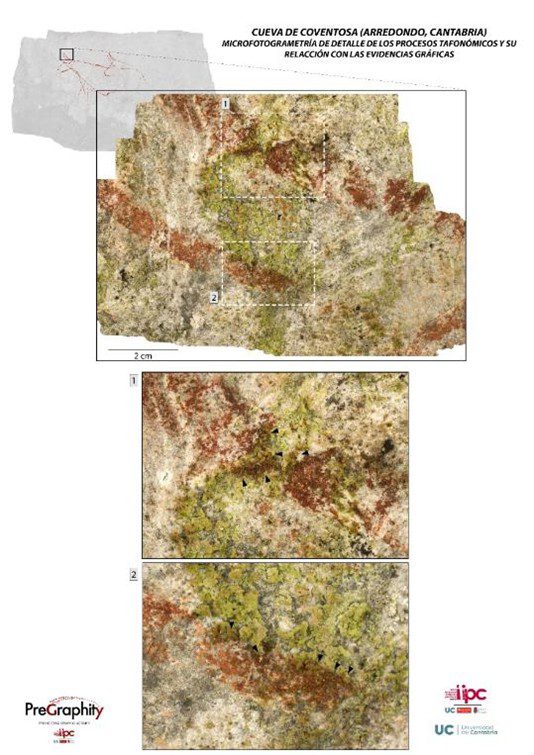

The Decisive Biological Evidence: The most conclusive factor was the stratigraphic relationship between the pigment and the organic life of the cave.
- The panel is colonised by algae and biofilm that only develop in humid and temperate climates (typical of the Holocene, our current era), being incompatible with the cold and dry climate of the Upper Palaeolithic (late Pleistocene).
- Microphotogrammetry analysis showed that the pigment was applied directly onto the living algae and biofilm (the pigment overlaps the algae). This finding is crucial: if the paintings had been made in the Palaeolithic, the pigment should be underneath or, at the very least, have been colonised by the organisms; however, they were executed at a time when these thermophilic algae (which require a warm climate) were already growing on the wall.
Conclusion
The rigorous application of authentication criteria (archaeological, geoarchaeological and bioarchaeological) confirmed that the Coventosa paintings are not Palaeolithic rock art.
The diagnosis of recent chronology is based on the fact that the painting is superimposed on living Holocene organisms (a determining criterion). Therefore, the graphic ensemble is an example of forgery or imitation carried out in contemporary phases.