
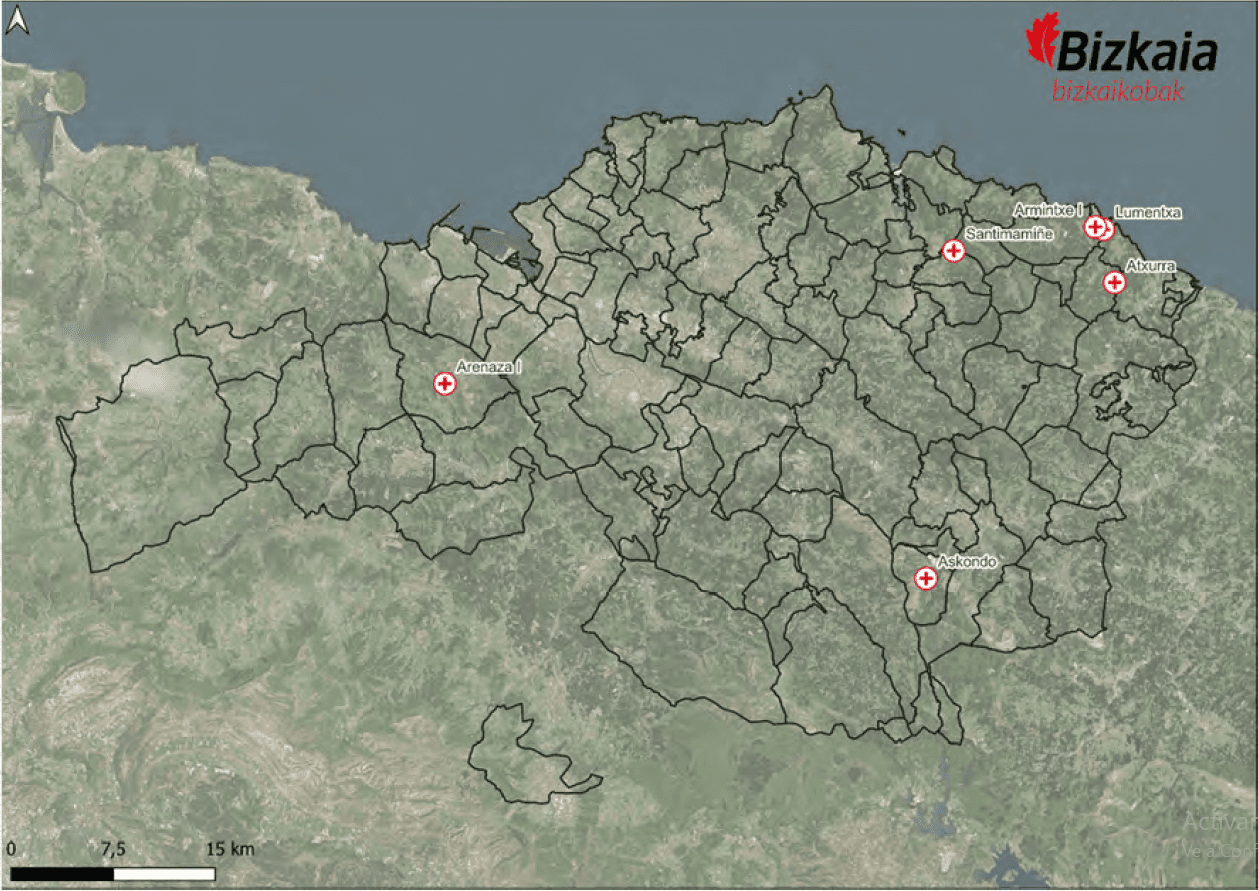
 The project is motivated by conservation issues identified in the decorated Palaeolithic caves of Bizkaia, as evidenced in previous projects such as the ‘DIAGNOSTIC STUDY AND PROPOSAL FOR CORRECTIVE MEASURES…’. A previous project in 2021, called ‘Labartest,’ had already made it possible to monitor the inscriptions at Santimamiñe and Lumentxa. The results of Labartest showed that some paintings in Santimamiñe suffered from taphonomic problems (such as the generation of crystals and high water activity) that required regular monitoring. On the other hand, Lumentxa showed great stability. However, environmental monitoring in Lumentxa ended in 2023. The decorated Palaeolithic caves are cultural heritage sites of great value and extreme fragility, exposed to risk factors such as geological evolution, deterioration due to visits and the dynamics of climate change. The study focuses on six caves with Palaeolithic pigments in Bizkaia, all classified as Assets of Cultural Interest by the Basque Government.
Objectives
The main objective of the project is to establish a roadmap that allows the administration to ascertain the specific diagnosis of the state of conservation of the six heritage sites with Palaeolithic pigments in Bizkaia and to propose possible corrective measures to ensure an appropriate policy for their research, conservation and dissemination.
The following specific objectives were established for Armintxe, Lumentxa, Atxurra, Arenaza, Santimamiñe and Askondo:
- Photogrammetric monitoring of taphonomic and geomorphological processes on the decorated panels. This involves three-dimensional restoration using close-range photogrammetry of the main panels and the use of algorithms to detect nuances that are imperceptible to the naked eye. This work would be carried out every four months.
- Colorimetric monitoring of the state of conservation of the paintings and supports, including colour calibration to monitor future processes that affect heritage assets. This would be carried out every four months (three times per annual cycle).
- Preparation of geomorphological maps of the monitored panels to obtain a micro-topographic map of the supports, identify the most fragile or problematic points, and focus monitoring efforts.
Methodology
The methodology combines fieldwork to compile data and laboratory work to organise the information into a database.
Photogrammetric Monitoring and Geomorphology: The SFM (Structure From Motion) photogrammetric technique was used with Agisoft Metashape Pro® software to obtain three-dimensional models with sub-millimetre geometric accuracy and high-resolution photorealistic texture. To this end, controlled homogeneous lighting (using flash equipment) and specific photographic parameters (fixed or focal optics between 24 and 50 mm, RAW format) were ensured to maximise quality and avoid digital noise. Orthophotos and 3D models are generated that allow for macro-level recognition of taphonomic processes (exfoliation, mineral deposits, water activity, bacterial growth, etc.). To ensure homogeneity, lighting conditions and camera positioning are replicated using reference targets.
Colorimetric Monitoring: Indirect characterisation methods based on digital image colour management were applied, using standardised colorimetric scales such as ColorCheker®. This allows the image tone to be calibrated until the actual colour is achieved and numerical measurements of the motifs in the LAB and RGB colour spaces are obtained. Quality control is performed using Frame® software and the Delta e (ΔE*ab) metric, which quantifies the difference between colours. It is planned to combine this with direct characterisation using a portable colorimetric sensor (without direct contact). Future physical-chemical characterisation using portable Raman spectroscopy is also being considered to understand the composition and degradation of pigments and lithochemical formations.
Results
A total of six panels (one per cave) were selected, located in different morphological environments and presenting diverse taphonomic problems. The results of the initial monitoring are based on two or three photogrammetric models produced at the end of the project (30 November 2024).
The diversity of processes identified allows for the creation of a unique catalogue of specific problems for the caves of Bizkaia. The panels studied show damage to the rock surface and different motifs (engraved and painted).
Bizkaia has a rock art heritage of great importance, such as Santimamiñe (a UNESCO World Heritage Site), which faces various conservation issues. The monitoring project, carried out during 2024, has enabled the initiation of a monitoring and control process that must be maintained in the long term. It is crucial to continue the tasks of inspecting protection systems, controlling biological activity, and diagnosing and proposing corrective measures. Having sustained information over time on the damage will allow the administration to make informed choices about the best preventive measures for future processes that may threaten Bizkaia’s underground cultural heritage.