
The action began after the Cultural Heritage Service of the Government of Cantabria reported in February 2023 the discovery of some paintings that had been presented as a possible unpublished collection of cave art. To address this request, the research team designed a proposal for documentation and scientific analysis focused on verifying their authenticity.
The El Camello cave is located in Casasola (Ruiloba, Cantabria) and is a small fossil conduit (about 50 metres long). Prospecting work suggests that this cavity was not open in times as ancient as those of Cantabrian cave art, but rather that its opening is recent and probably linked to the exploitation of the La Vega Mine, an open-pit mine that operated from the second half of the 19th century until the 1930s.
Objectives
The main objective of the work was to verify the authenticity of the paintings located in El Camello. To this end, the following specific objectives were established:
- To exhaustively document the graphic evidence and identify possible signs of antiquity and technical-stylistic features comparable to authentic cave art.
- To conduct a comprehensive survey of the cave in search of archaeological remains.
- To obtain samples for C14 dating and for the physicochemical analysis of the pigments.
Methodology
The methodology employed included:
- Archaeological Survey: Systematic examination of the floors, walls, and ceilings of the cavity. This floor survey yielded no archaeological material.
- Photographic Documentation: Comprehensive documentation was carried out, including general and macro-level photographs. Nikon® equipment was used, and standardised colour scales were employed.
- Technical-Formal Analysis: Information was collected on the techniques used, formal features and taphonomic processes to assess their authenticity.
- Sampling for Radiocarbon Dating (C14 AMS): Sample CM1 was taken from Graphic Unit CM.A.III.01 (possible bison), where charcoal was used. Pre-treatment included protocols with HCl and NaOH to remove contaminants such as humic acids.
- Physicochemical Analysis: Six pigment samples were taken to analyse their composition. This included characterisation using Scanning Electron Microscopy (SEM) and an approximation using portable Raman Spectroscopy.
Results
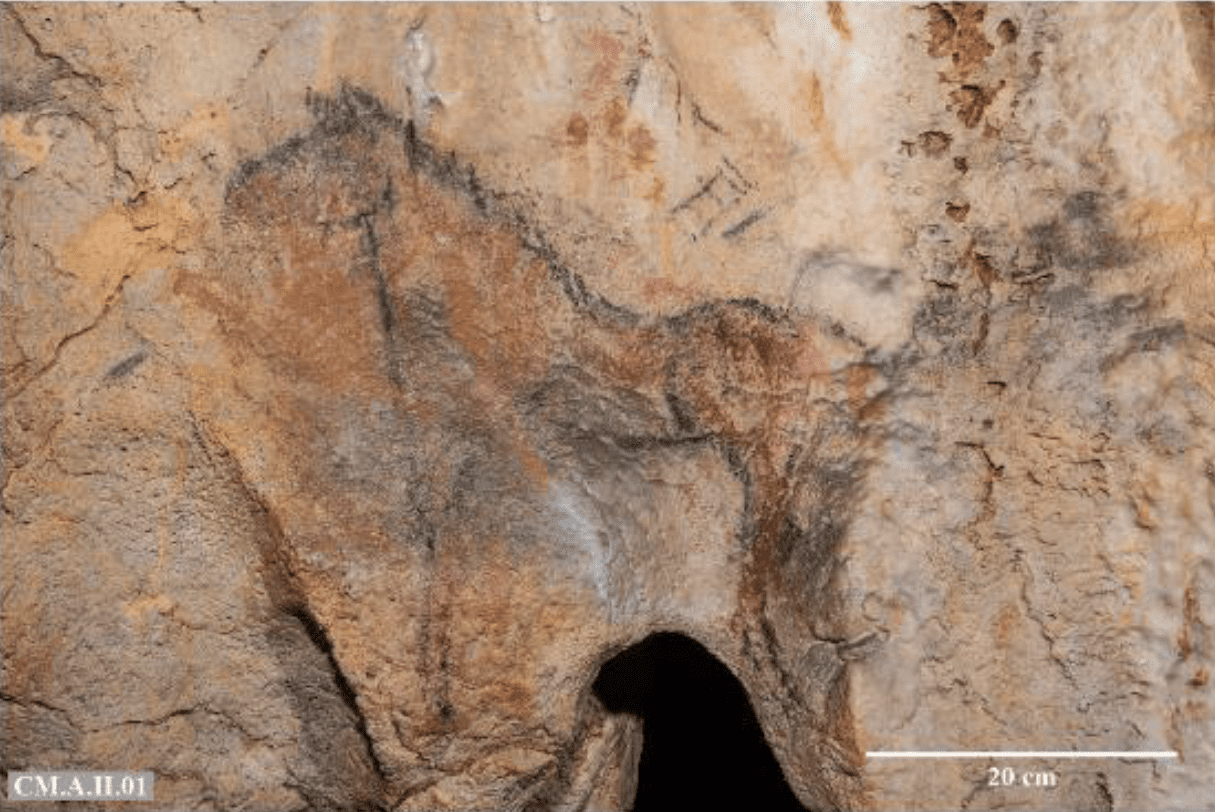
Twenty-eight graphic units (GUs) were identified, distributed across nine panels. These include figurative representations (horses, possibly bison) and symbols (hands, quadrilaterals, punctuation marks). The results of the multidisciplinary analysis conclusively point to the paintings being fake:
- a) Chronological and analytical evidence
1. C14 dating: The charcoal used to draw Graphic Unit CM.A.III.01 (possible bison) was found to be of recent origin, dating from between the 17th and 20th centuries. This data is decisive in ruling out Palaeolithic authenticity.
2. Geological Context: The absence of an archaeological site in the cave, together with its opening linked to modern mining (after the 19th century), reinforces the conclusion that the drawings are recent.
- b) Stylistic and Technical Evidence (Poor Quality Fakes)
1. Style and Proportions: The figurative figures (bison, horses) simulate typical representations of Cantabrian Palaeolithic art (such as the retreating bison of Altamira), indicating that the author was a connoisseur who attempted to reproduce them. However, they display successive stylistic and anatomical errors, such as incorrect use of perspective, crude execution of details, and problems of disproportion (e.g., very narrow figures or figures with excessively long legs).
2. Execution Techniques: A lack of control was observed in the mastery of techniques such as engraving, where the author was unable to deepen the line and the resulting profile does not resemble that left by Palaeolithic stone tools. In addition, parallel longitudinal striations were identified in the fingerprints (CM.C.II.01), suggesting the rubbing of a finger covered with a glove or fibre element during application, a clear modern indication.
3. Taphonomic Analysis: No calcite coatings, patinas, or significant degradation processes typical of paintings thousands of years old were identified. The pigment was applied to ancient calcite formations and even small active speleothems, and in no case were calcite coatings superimposed on the paintings identified that would indicate great age.
The set of paintings found in El Camello Cave is a clear example of imitation/forgery, simulating the Palaeolithic style but created in recent times.
Radiocarbon dating, which places the charcoal between the 17th and 20th centuries, combined with stylistic and technical evidence and the recent opening of the cave, are decisive arguments for ruling out its authenticity. This case highlights the need for both researchers and the administration to follow strict protocols (such as the manual of good practices and the sample traceability system) for the responsible management of this fragile cultural heritage.